Paper · 22 Sep 2026
Impact model puts the RNA World's best window at about 4.33 billion years ago
Abramov, Medvegy, Kremer, Mojzsis · Nature Communications
In a sentence
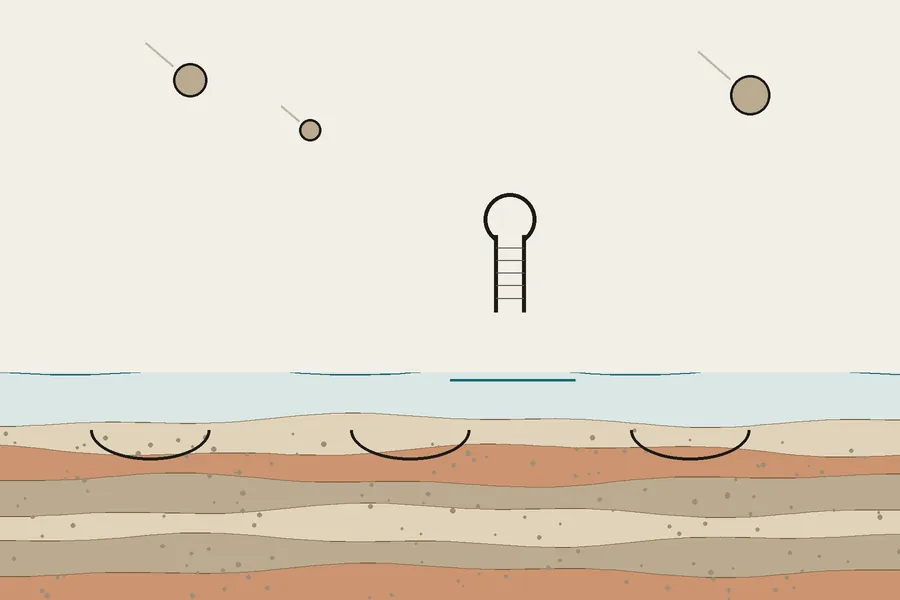
A 3-D model of Hadean impacts finds the crust stopped being sterilized about 4.4 billion years ago, with a sweet spot for RNA chemistry near 4.33.
In plain words
The young Earth was pounded by asteroids that heated its crust. This team simulated that heating across the whole planet and checked it against the oldest zircon crystals. Before about 4.4 billion years ago, impacts kept wiping out any fragile molecules. After that, cooler pockets and hot springs persisted, peaking around 4.33 billion years ago, a bit before most estimates of the last universal common ancestor.
Technical detail
3-D thermal bombardment model, 0.13-0.57 wt% delivered mass, zircon benchmark. Sterilization until about 4.4 Ga; biocompatible near-surface volume > 90% by 4.3 Ga; sweet spot 4.33 Ga (shifts to about 4.4 Ga at 0.13 wt%). Sensitive to the assumed delivered mass.
What we take from it
Background
Context only: it sets the geological clock that LUCA-size arguments are measured against.
Source checked against its DOI. Read the original.